


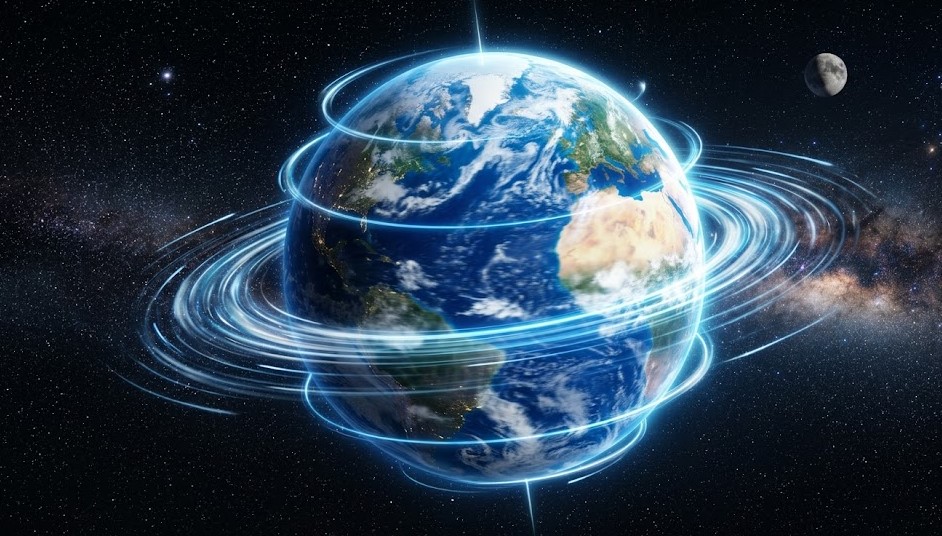
Earth does not spin at the same speed everywhere; instead, its rotation speed changes depending on how far you are from the equator. At the equator, the Earth moves the fastest, reaching about 1,674 kilometers per hour (1,040 miles per hour) because this region has the largest circumference to cover in 24 hours. As you move away from the equator toward higher latitudes, the rotational speed gradually decreases because those locations trace smaller circles during Earth’s spin.
At the poles, the rotational speed is almost zero because they are located directly on Earth’s axis of rotation. Even though every point on Earth completes a full rotation in the same 24-hour period, the distance traveled differs greatly. This variation explains why airplanes, weather patterns, and even satellite paths are influenced by latitude, making Earth’s rotation a key factor in global movement and navigation systems.
Why we don’t feel Earth’s rotation
Even though Earth is spinning at incredibly high speeds, we don’t feel this motion because everything around us—including the air, oceans, buildings, and even our own bodies—is moving along with the planet at the same constant speed. Since there is no sudden change in motion, our senses cannot detect the rotation. This is similar to being inside a smoothly moving airplane; when the flight is steady, passengers do not feel the speed unless there is turbulence or acceleration.
Another reason we don’t feel Earth’s spin is because the rotation is extremely stable and uniform. There are no sharp jerks or sudden changes in direction that could signal movement to our bodies. Additionally, gravity plays a major role by holding everything firmly toward Earth’s surface, balancing out the effects of rotation. As a result, the motion becomes completely normal to us, even though we are constantly traveling through space at high speed
Earth’s rotation speed and the day-night cycle
The day-night cycle we experience every day is a direct result of Earth’s rotation speed. As Earth spins on its axis, different parts of the planet face the Sun at different times. The side facing the Sun experiences daylight, while the opposite side is in darkness, creating night. This continuous rotation is what divides time into days and nights in a perfectly repeating cycle.
This rotation takes roughly 24 hours to complete one full turn, which is why we have a 24-hour day. As Earth rotates, sunrise occurs when a location begins to face the Sun, and sunset happens when it rotates away. This process is not just important for timekeeping but also influences temperature changes, weather patterns, and even biological rhythms in humans and animals, making Earth’s rotation essential for life on the planet.
Scientific measurements and NASA insights
Scientists have studied Earth’s rotation speed for centuries using advanced tools like atomic clocks, satellites, and space-based observations. These measurements show that Earth completes one full rotation in about 23.93 hours, which is slightly less than a standard 24-hour day. This precise measurement is called a sidereal day, and it helps scientists track Earth’s movement relative to distant stars rather than the Sun.
According to modern space research, especially from NASA, Earth’s rotation is not perfectly constant. It can vary slightly due to natural forces such as ocean tides, atmospheric changes, and seismic activity. Even tiny variations of milliseconds are carefully recorded because they are important for GPS systems, satellite communication, and global timekeeping standards. These high-precision measurements help scientists understand how dynamic our planet truly is.
Is Earth’s rotation slowing down?
Over very long periods of time, Earth’s rotation speed is slowly decreasing. This means that days on Earth are becoming slightly longer, but the change is extremely small and happens over thousands to millions of years. Scientists have found that Earth used to spin faster in the distant past, meaning days were shorter than they are today. This gradual slowing is mainly due to the gravitational interaction between Earth and the Moon.
The Moon creates tidal friction on Earth, which acts like a braking force. As ocean tides move, they transfer a tiny amount of Earth’s rotational energy to the Moon’s orbit. This causes Earth to slow down very gradually while the Moon moves slightly farther away. Although this process is measurable with precise instruments, it is so slow that it has no noticeable effect on daily human life.
What affects Earth’s rotation speed
The Earth’s rotation speed is not completely fixed and can change slightly due to several natural and physical factors. One of the most important influences is the gravitational pull of the Moon and the Sun, which creates tides in Earth’s oceans. These tides generate friction as they move, slowly transferring energy and causing tiny variations in how fast Earth spins.
Another major factor is changes inside Earth itself. Movements of molten material in the core, shifting tectonic plates, earthquakes, and even large weather systems like El Niño can redistribute Earth’s mass. When mass shifts closer to or farther from Earth’s axis, it can slightly speed up or slow down rotation—similar to how a spinning figure skater changes speed when pulling their arms in or stretching them out. Although these changes are very small, they are carefully tracked by scientists because they affect precise systems like satellites and global timekeeping.
Real-life impacts (GPS, timekeeping, navigation)
The Earth’s rotation speed plays a very important role in modern technology, especially in systems that depend on extreme accuracy. One of the biggest impacts is on GPS navigation. Satellites orbiting Earth must constantly adjust for Earth’s rotation to provide correct positioning data. Even a tiny miscalculation in rotation speed could lead to errors of several meters, affecting maps, driving directions, aviation, and even emergency services.
Timekeeping is another area where Earth’s rotation is crucial. Our 24-hour day is based on how long Earth takes to complete one spin, but because the rotation is not perfectly constant, scientists occasionally add or adjust time using “leap seconds” to keep atomic clocks aligned with Earth’s actual movement. Navigation systems, including air traffic control and maritime routes, also rely heavily on precise rotational data to ensure safe and accurate travel across the globe.
Fun comparisons with everyday objects
To better understand Earth’s rotation speed, it helps to compare it with things we experience in daily life. At the equator, Earth spins at about 1,674 km/h, which is much faster than a commercial airplane that typically flies at around 900 km/h. This means you are actually moving through space faster than a jet aircraft, even while standing still on the ground.
Another interesting comparison is with a bullet, which can travel around 1,000–1,500 km/h depending on the firearm. Even then, Earth’s equatorial speed is still higher. However, because this motion is smooth and constant, we never feel it. It is like being on a giant, perfectly smooth spinning ride that never stops or shakes, making Earth’s rotation one of the most fascinating hidden motions in our everyday life.
Conclusion
The study of Earth’s rotation speed reveals how dynamic and constantly moving our planet really is, even if we don’t feel it in our daily lives. From spinning at nearly 1,674 km/h at the equator to completing a full rotation in about 24 hours, this motion is responsible for essential natural processes like the day-night cycle, weather patterns, and even timekeeping systems. It is a silent but powerful force that shapes life on Earth in countless ways.
Although Earth’s rotation is extremely stable, it is not perfectly constant and slowly changes over long periods due to gravitational forces, internal Earth dynamics, and external influences like the Moon. These tiny variations may seem insignificant, but they play a major role in advanced technologies such as GPS navigation and atomic time systems. Understanding this hidden motion helps us better appreciate how precisely balanced our planet truly is.
FAQs
1. How fast does Earth rotate at the equator?
Around 1,674 km/h (1,040 mph).
2. Does Earth rotate at the same speed everywhere?
No, it is fastest at the equator and slowest at the poles.
3. Why don’t we feel Earth spinning?
Because everything around us moves at the same constant speed.
4. Is Earth’s rotation changing over time?
Yes, it is very slowly slowing down due to tidal forces.
Visit to Washington Times for more info
