


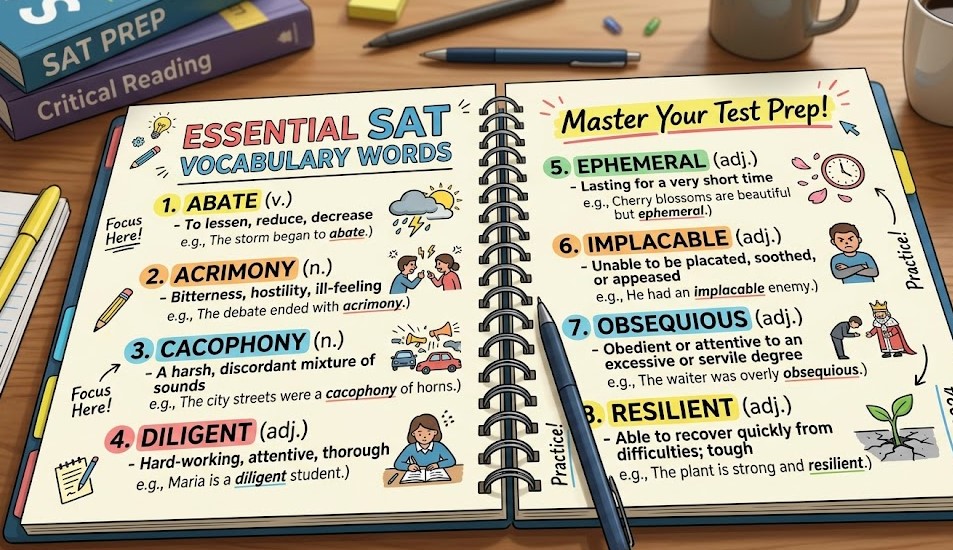
The importance of sat vocabulary words has not disappeared even though the SAT format has changed over the years. Instead of asking students to memorize long lists of words, the exam now focuses on how well they understand vocabulary in real reading passages. This means students must recognize word meanings through context, tone, and sentence structure, which makes vocabulary knowledge still essential for success. Without a strong vocabulary base, it becomes difficult to fully understand complex academic texts, which directly affects reading comprehension scores.
Another reason SAT vocabulary still matters is that it builds overall academic readiness. College-level reading and writing require familiarity with advanced words that often appear in SAT passages. When students develop strong vocabulary skills, they can interpret arguments more clearly, analyze ideas faster, and answer questions with greater accuracy. This is why many educators still emphasize learning sat vocabulary words as a foundation for improving both test performance and long-term academic skills.
High-Frequency SAT Vocabulary Word List
A strong sat vocabulary words list focuses on terms that frequently appear in SAT reading passages and answer choices. These words are not random; they are selected based on how often they show up in academic texts, literature, and college-level materials. Learning these high-frequency words helps students quickly understand passages without stopping to guess meanings, which saves valuable time during the exam.
Some of the most common SAT vocabulary words include abate, ambiguous, benevolent, corroborate, impede, lucid, and pragmatic. These words often appear in context-based questions where students must determine meaning from surrounding sentences. High-frequency vocabulary lists usually include a mix of medium and advanced-level words, ensuring students are prepared for both simple and complex passages. Building familiarity with these words improves reading speed and accuracy, which directly supports higher SAT scores.
Learning Words in Context (Not Memorization)
Modern sat vocabulary words preparation is no longer about memorizing long definitions in isolation. Instead, the SAT tests how well a student understands a word’s meaning based on the surrounding sentence or paragraph. This approach encourages deeper comprehension because students must analyze how a word functions within a specific idea rather than relying on rote learning. As a result, contextual learning has become the most effective way to build vocabulary skills for the exam.
When students learn words in context, they naturally improve their reading comprehension abilities. For example, understanding how a word changes meaning depending on tone or sentence structure helps in solving inference-based questions. This method also strengthens critical thinking because students begin to recognize patterns in how academic language is used. Over time, practicing sat vocabulary words in real passages builds confidence and makes it easier to handle unfamiliar texts during the actual test.
Best Strategies to Master SAT Vocabulary
Mastering sat vocabulary words requires consistent practice and the right learning strategies rather than quick memorization. One of the most effective methods is reading high-quality material such as academic articles, editorials, and literature passages. This exposes students to advanced vocabulary in natural contexts, helping them understand how words are actually used instead of just memorizing definitions.
Another powerful strategy is active learning through repetition and usage. Instead of simply reading word lists, students should practice using new words in sentences, flashcards, and short writing exercises. Grouping words by meaning or theme—such as positive, negative, or neutral tone—also helps in faster recall during exams. Regular revision is essential because sat vocabulary words are best retained when they are reviewed multiple times over a period of days or weeks, not in a single study session.
Common Mistakes Students Make
Many students struggle with sat vocabulary words not because the words are too difficult, but because they use ineffective learning methods. One of the most common mistakes is trying to memorize long word lists without understanding how the words are used in context. This leads to short-term recall but weak long-term retention, which becomes a problem during the actual SAT reading section.
Another frequent mistake is ignoring reading practice and focusing only on vocabulary drills. Since the SAT tests words within passages, students who skip regular reading fail to understand how meanings change depending on sentence structure. Some students also rely too heavily on guessing meanings without checking context clues, which often leads to wrong answers. Avoiding these mistakes is essential for building strong mastery of sat vocabulary words and improving overall test performance.
Sample SAT Vocabulary Table
A structured approach to sat vocabulary words can make learning much easier, especially when students organize words into a simple reference table. Instead of random memorization, grouping words with meanings and example usage helps the brain retain information more effectively. This method is widely recommended because it combines visual learning with practical application.
Below is a sample table of commonly tested SAT vocabulary words that appear frequently in reading passages and practice exams. These words are selected because they represent different difficulty levels and are often used in academic contexts.
| Word | Meaning | Example Usage |
|---|---|---|
| Ambiguous | Unclear or having multiple meanings | The instructions were ambiguous and confused many students |
| Corroborate | To confirm or support with evidence | The witness helped corroborate the suspect’s story |
| Pragmatic | Practical and realistic | She took a pragmatic approach to solving the issue |
| Lucid | Clear and easy to understand | His explanation was lucid and simple |
| Impede | To slow down or block progress | Heavy traffic can impede emergency vehicles |
Using tables like this allows students to quickly revise sat vocabulary words without feeling overwhelmed. It also improves memory retention because the brain connects meaning with examples, making recall easier during the exam.
Expert Tips for Fast Improvement
Improving your mastery of sat vocabulary words quickly requires a smart and focused study approach rather than long hours of passive reading. One expert tip is to learn words in small daily batches instead of trying to memorize large lists at once. Studying 10–15 words per day with proper revision is far more effective than cramming hundreds of words in a single session. This steady exposure helps the brain naturally retain meanings over time.
Another highly effective strategy is to combine vocabulary learning with active reading practice. When students encounter new words in passages, they should pause briefly to infer meaning from context before checking a dictionary. This strengthens understanding and improves reading speed. Experts also recommend using spaced repetition techniques, where sat vocabulary words are reviewed at increasing intervals to strengthen long-term memory. Consistent practice, rather than intensity alone, leads to the fastest improvement in SAT performance.
Conclusion
Mastering sat vocabulary words is an essential part of building strong reading comprehension skills for the SAT exam. Even though modern SAT questions focus more on context than direct memorization, vocabulary still plays a major role in helping students understand complex passages, identify tone, and interpret meaning accurately. A strong vocabulary foundation directly improves both speed and confidence during the test.
The most effective approach is not memorization but consistent exposure, practice, and contextual learning. Students who regularly read academic material, review high-frequency words, and apply them in real sentences tend to perform better. By focusing on understanding rather than rote learning, learners can steadily improve their grasp of sat vocabulary words and achieve higher SAT scores with less stress.
FAQs
1. What are SAT vocabulary words?
SAT vocabulary words are academic-level words commonly used in SAT reading passages and questions. They help test a student’s understanding of meaning in context rather than simple memorization.
2. Do I still need to memorize SAT vocabulary?
No, memorization is not the main focus anymore. The SAT emphasizes understanding words through context, but learning common sat vocabulary words still improves reading comprehension.
3. How many vocabulary words should I learn for SAT?
There is no fixed number, but learning 500–1000 high-frequency academic words can significantly improve your understanding of SAT passages.
4. What is the best way to learn SAT vocabulary?
The best method is learning words in context through reading passages, using flashcards, and practicing regularly instead of rote memorization.
Visit to Washington Times for more info
