


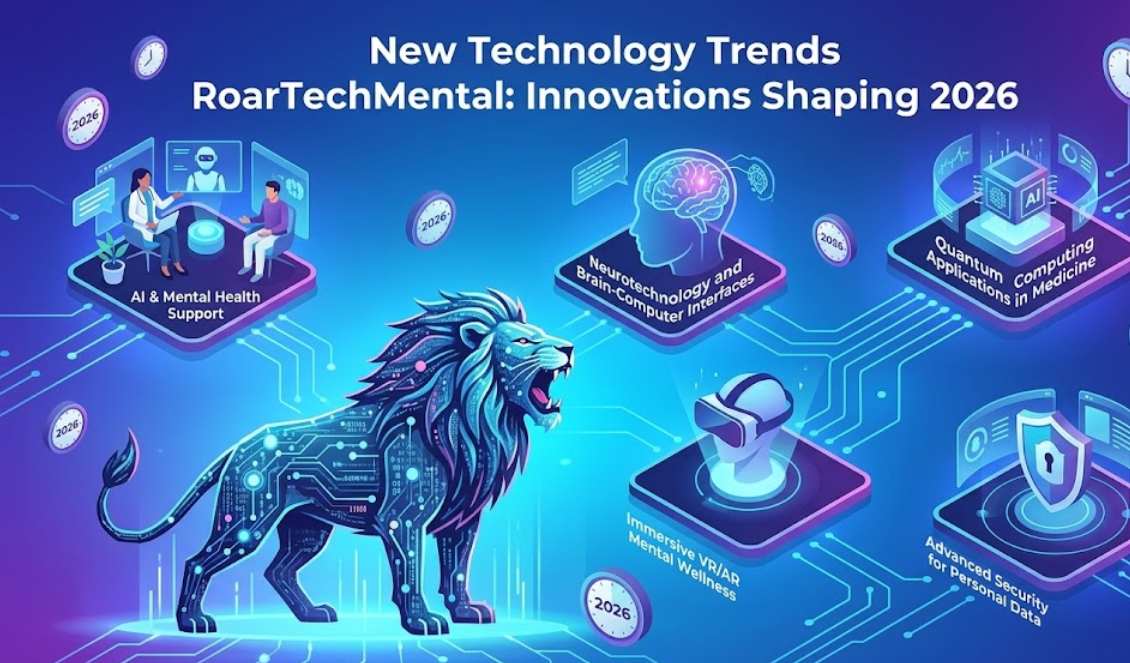
The landscape of technology is evolving faster than ever, and new technology trends RoarTechMental are at the forefront of this transformation. Businesses, governments, and individuals alike are witnessing a surge of innovations that promise to reshape industries, improve efficiency, and enhance daily life. From agentic AI systems that can perform tasks autonomously to sustainable computing solutions addressing environmental concerns, 2026 is poised to be a pivotal year for tech adoption.
Understanding these trends is not just a matter of curiosity—it’s a strategic necessity for businesses and professionals aiming to stay competitive. In this article, we explore the most significant technology trends of 2026, their practical applications, and insights on how to leverage them effectively.
Artificial Intelligence Evolution
Artificial Intelligence continues to dominate the technology landscape, but in 2026, it is entering a new phase of maturity. RoarTechMental trends highlight three primary areas of AI innovation: agentic AI, physical AI, and domain-specific language models.
Agentic AI and Multimodal Systems
Unlike traditional AI assistants that respond passively to commands, agentic AI can plan, reason, and execute complex, multi-step tasks independently. These systems are multimodal, analyzing text, images, and audio simultaneously, enabling advanced decision-making in areas like finance, logistics, and healthcare.
Example: An agentic AI can autonomously analyze a supply chain disruption, suggest alternative vendors, and even place orders, reducing human intervention.
Statistics: Gartner predicts that by 2026, over 40% of enterprise AI deployments will rely on agentic AI capable of independent task execution.
Physical AI and Humanoid Robots
AI is gaining a “physical presence” through humanoid and collaborative robots. These robots combine advanced machine learning with robotics to interact with the real world, offering solutions in manufacturing, logistics, and customer service.
Example: Humanoid robots in warehouses can pick and pack items, optimizing operations and reducing labor costs.
Domain-Specific Language Models
Rather than using generic AI models, companies are adopting domain-specific language models trained for specialized industries such as law, healthcare, or finance. These models provide higher accuracy and contextually relevant insights, enhancing productivity and decision-making.
Infrastructure and Security Advancements
Modern AI systems and digital platforms require powerful infrastructure and robust security. RoarTechMental trends in infrastructure focus on AI supercomputing, proactive cybersecurity, and confidential computing.
AI Supercomputing and Specialized Chips
High-performance computing is essential for running large AI models. Companies like NVIDIA continue to innovate with AI-optimized chips, enabling faster and more energy-efficient computations.
Example: AI supercomputers are now used in drug discovery, climate modeling, and real-time language translation.
Preemptive Cybersecurity
As AI adoption grows, so do AI-driven threats. Modern security systems are shifting from reactive measures to preemptive cybersecurity, using AI to monitor networks, detect anomalies, and neutralize threats in real time.
Confidential Computing and Data Privacy
Data protection is evolving beyond storage and transmission. Confidential computing allows organizations to process sensitive data securely without exposing it, ensuring privacy compliance and reducing breaches.
Digital-Physical Convergence
The blending of digital and physical technologies is driving innovation across industries. Spatial computing, smart glasses, edge computing, and next-gen connectivity are at the forefront of this trend.
Spatial Computing and Smart Glasses
AR and VR devices are becoming lighter, more immersive, and practical beyond gaming. Applications include workplace collaboration, education, and navigation.
Example: Field engineers use AR glasses to overlay schematics onto machinery, improving repair accuracy.
Edge Computing with 5G and 6G
Processing data near its source, or edge computing, minimizes latency for IoT devices, autonomous vehicles, and smart cities. Combined with 5G and emerging 6G networks, edge computing enables real-time analytics and seamless user experiences.
Sustainability and Future Tech
Sustainability is a critical focus in technology development. Green computing, quantum computing, and digital provenance are reshaping how we use and trust technology.
Green Computing
Tech giants are prioritizing energy efficiency through advanced cooling systems, low-power processors, and sustainable data centers. These initiatives reduce carbon footprints while maintaining high-performance AI capabilities.
Quantum Computing
Although still emerging, quantum computing is making strides in specialized fields like encryption, complex simulations, and drug discovery. It represents the next frontier of computational power.
Digital Provenance and Blockchain
Blockchain technology ensures the authenticity and origin of digital content, crucial for combating deepfakes and verifying digital assets.
Emerging Health and Societal Trends
Technology is also shaping healthcare, mental wellness, and societal behavior.
AI-Driven Health and Mental Care
Wearable devices now monitor physical and mental health in real time. AI provides personalized insights for stress management, sleep optimization, and even therapeutic interventions.
Digital Minimalism
Countering digital overload, the movement toward digital minimalism encourages mindful use of devices and non-connected alternatives to improve well-being.
Example: Minimalist smartphones limit notifications to reduce distraction while maintaining essential functionality.
Actionable Insights for Businesses and Individuals
- Invest in AI adoption early – leverage agentic and domain-specific AI for competitive advantage.
- Prioritize infrastructure upgrades – adopt AI-optimized chips and edge computing for performance.
- Focus on security and privacy – integrate preemptive cybersecurity and confidential computing.
- Embrace sustainable technology – implement energy-efficient systems and green computing practices.
- Monitor societal trends – balance high-tech adoption with digital minimalism for workforce well-being.
Conclusion: Staying Ahead with RoarTechMental Trends
The new technology trends RoarTechMental are redefining how we live, work, and innovate. From AI-driven systems and humanoid robots to green computing and digital-physical integration, these technologies present unprecedented opportunities. Businesses and individuals who understand and adopt these trends proactively will remain competitive and relevant in 2026 and beyond.
FAQs:
Q1: What are the most impactful technology trends in 2026?
A: AI evolution, digital-physical convergence, sustainable computing, quantum computing, and AI-driven healthcare are among the top trends.
Q2: How can businesses leverage agentic AI?
A: By implementing AI systems that autonomously plan and execute tasks, businesses can optimize operations, reduce errors, and enhance efficiency.
Q3: Why is confidential computing important?
A: It protects sensitive data during processing, not just storage or transmission, ensuring higher privacy and compliance.
Visit to Washington Times for more info
